
Fighting for Film Jobs: Peter Berg on “The Mosquito Bowl,” MPTERA, and Saving American Production
Director Peter Berg wanted to film his all-American war and sports drama, The Mosquito Bowl, in California, but making it work financially was one battle he couldn’t win. Because of the available tax breaks, the Lone Survivor and Friday Night Lights filmmaker had no choice but to shoot it in Australia.
That is why Berg supports the Motion Picture, Television, and Entertainment Revitalization Act (MPTERA), a bipartisan federal bill introduced in Congress to create a national tax incentive for domestic film and television production. He also wants incoming California Governor Xavier Becerra to move forward with additional incentives announced by outgoing Governor Gavin Newsom to keep as much work in The Golden State as possible.
The Mosquito Bowl tells the true story of elite college and professional football players serving as US Marines during World War II and the brutal invasion of Okinawa, Japan. Nicholas Galitzine, Bill Skarsgård, Ray Nicholson, and relative newcomer Tom Francis play the athletes-turned-band-of-brothers-turned-military-legends in Berg’s anti-war film.
Here, Berg, who also produced and co-wrote The Mosquito Bowl, tells The Credits that filmmakers and powerhouse execs, including Skydance Corporation CEO David Ellison, are on board with MPTERA, hoping Congress can help revitalize the U.S.-based productions that were the hallmark of the industry for more than a century. The Mosquito Bowl is in theaters now and streams on Netflix on November 25.
Do you agree that some people view films set in contemporary conflicts, such as Lone Survivor, differently from ones set in World War II, like The Mosquito Bowl?
Our human instinct is to avoid pain, suffering, and trauma. We want to be happy, laugh, and go online, scroll, and look at whatever gets us off. We don’t want to sit with certain truths because they’re uncomfortable. That’s human nature. The Buddhists talk about Saṃsāra, this cycle of suffering, with humans running towards pleasure and away from pain. You’re probably right because Lone Survivor is more contemporary; it had an action component, but it was easy to watch, and we weren’t really reminded that we’ve been in these forever wars. While we’re sitting here talking, you can go on your phone and look at TikTok videos of what’s happening in Ukraine, then you scroll, and it’s a Skims commercial or an NFL highlight reel of the hardest hits. You have to work to get people to want to experience the brutality of a real war film, because it hurts, and it forces you for two hours and 40 minutes to not be able to escape. It’s harder for young people in particular because they don’t know what Pearl Harbor really was. They certainly don’t understand the history that preceded it, what Japan was doing to China, and how Hitler studied Japan’s behavior towards China and then came up with his genocidal ideologies.

The Mosquito Bowl is a very American story, but it was shot in Australia. Would you have preferred to have filmed it here?
I did not want to go to Australia to film this movie. I could have easily shot it in Hawaii or parts of Southern California, but we couldn’t compete. We need a [improved] tax credit, particularly in California. Gavin Newsom has introduced a bill I think is meaningful, and I hope the new administration puts that forward. If we don’t get a meaningful credit, particularly in Southern California, there’s no way films will be shot here. If you were the boss and it was your money, you wouldn’t do it. You’re getting a 42 percent return on the dollar going to Australia. I say this with full respect for the Australian crew because they are wonderful people, but I have lots of friends: grips, stunt guys, electricians, makeup people, hair people, costume people who live in California, and they are really upset. They call me like, “Please, can we shoot it here?” I’m like, “I’m not in charge of that. We can’t.” Then it’s, “Can I come to Australia?” and it’s like, “Nope.”
There is hope with the bipartisan MPTERA bill, which the MPA is strongly supporting, and that would help every state.
Yeah, but I’m talking about Los Angeles and California, where I live and where I have been for a long time. You can go to New Jersey right now, and they are offering the tax credit. Georgia’s still offering it. Albuquerque, New Mexico, is doing pretty well, and so is New York. When you look at California and filming in Los Angeles versus these other states, or Australia, Canada, or the UK, we can’t compete. When I moved to LA and went to Universal Studios for the first time, it felt like being Dorothy in The Wizard of Oz. These studios were magical places, teeming with life, work, and energy. Go tour Warner Brothers, Paramount, or Sony right now, and they are ghost towns. I hate it. I talked to David Ellison about it, and he wants it too.
So, you have spoken to David about this directly?
Yes. He said he is deeply committed to getting a tax credit for California, and I believe him. He owns two studios. That’s his property. Why wouldn’t you want them full? If you get the federal incentive and you level the playing field, great, but then if Newsom’s bill throws another billion on top of it for California, ya know? David Ellison has bought two very big properties: the Warner Brothers and the Paramount lot, and I’ve been on both lately. They report something like 65 to 70 percent occupancy, but I didn’t see that. I shot a commercial on the Sony lot two weeks ago, and we were the only shoot on the entire studio lot. I believe these guys want to bring production back, and the second that tax credit comes, you’re going to see real occupancy on all the lots. I’m doing Call of Duty for Paramount, but let’s see when we’re ready to shoot and where we’ll shoot it. We don’t know yet, but it’ll be really hard to justify shooting it somewhere that’s 45 percent more expensive.

For The Mosquito Bowl, you reunite with Jacques Jouffret as your DOP. You mention you used Australian crew as well, but you made a very specific choice with Jacques. Why did you want to reunite with him?
Jacques and I have known each other a long time. I like to shoot a lot of wide-lens handheld, and he knows how I like to work. He, I, and my two operators, Brett Hurd and Richard Coy Aune, are a team. I’m very comfortable with them. Those are critical hires for me, and they’re part of my brain. I also had to bring in a few real football players because, as talented and athletic as Australian rugby and Aussie rules football players are, they didn’t know how to play American football. I did bring in a few ringers. Not to go back to the tax credit thing, but you can’t bring many because part of the deal is you have to hire local. You have to really pick and choose who you can bring.
I’d love to get your thoughts on the state of the union of film and filmmaking as we round out 2026.
Let’s look at it as a financial experience. I loved Obsession, The Odyssey, Digger, and You Can See Everything, so I’m going to the movies and really enjoying them. What does that mean for the health of the business? Well, I believe really good films are being made, so let’s start with that. The thesis that always used to be in play was that movie theaters are a recession-proof business because if the economy goes up, people see movies, and if the economy goes down, everyone’s depressed, so people see movies. That has obviously changed. Streamers have been a big part of that, and then COVID killed movie theaters, but we’re definitely seeing a return to the movie theater experience. The essential question is, “Can you create desire for a movie-going experience?” It’s not as simple as making good movies because we are making good movies and there are a lot of them. Now, the question is, “Can you get people with short attention spans who are living their lives on Instagram, X, and TikTok to drive to pay all this money, sit in a seat, shut up, and watch a movie, and feel good about it, then be like, ‘Yeah, I want to go see another one.'”? The movies have to be good, but AMC Theaters has to keep doing its job and make it fun. People have to start realizing that it’s not okay to live in a closet staring at your phone for five hours a day. I have a young son, so I know a lot of young people are acknowledging that phones are destroying their souls, so they need to get out, go to live events, restaurants, and movies, and that’s what has to happen. Hollywood is doing its job.
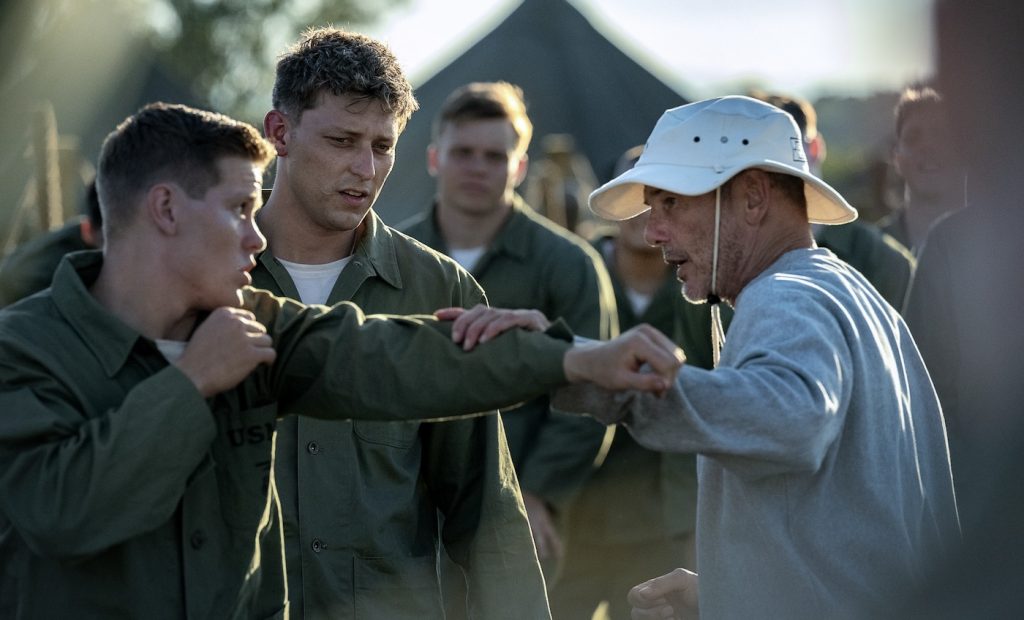
Featured image: The Mosquito Bowl. (Featured L to R) Peter Berg (Director) and Tom Francis in The Mosquito Bowl. Cr Kane Skennar / Netflix © 2026